
David Spratt posed the question Monday 27 July, 2026:
Could Four Billion People Die at 3°C?
The claim that four billion people could die in a 3°C warmer world has become a powerful climate narrative. But what does the science actually support, and where does evidence end and speculation begin?
David’s purpose was to debunk the exaggeration of deaths, but what I find to be a clear take-away is that masses of people will be adapting to an overheating world by fleeing those hottest places, heading to cooler regions. I recommend reading the entire article here, but if you want to get to the bottom line as I see it … read on below.
The world at 3°C
In a 3°C hotter world, large parts of the tropics will suffer “near-unlivable” extreme heat conditions, there will be less rainfall over significant parts of the dry subtropics, and this combined with increased evaporation rates will lead to drying out and desertification across the dry subtropics. New extremes — of rainfall and heat, flooding and drought — beyond human experience and beyond model expectations will occur. And a committed sea-level rise of many metres will be in the slow process of inundating coastal cities and deltas.
Some research, which is contested, suggests 3°C could cut global GDP by half. Last year, Australian researchers concluded that at 3°C, by the end of the century, the estimated harm to the global economy would be 40%, which “could devastate livelihoods in large parts of the world”. Coral reef systems would be gone, and that alone means coastal ecosystems would only be able to provide 20–50% of the fish protein that they do today for half a billion people around the world.
In 2021, the Australian Academy of Science published a report co-authored by David Karoly on Risks to Australia of a 3-degree warmer world. Amongst other things, it said that at 3°C, heatwaves would happen as often as seven times a year, with events lasting 16 days on average, “fire risk (driven by record heat, dryness and fuel) will increase by 30 per cent or more in south-eastern Australia”, and yields of key crops would reduce “by between 5 and 50%, depending on crop and location”. Other research estimates that “beyond 2°C warming, the declines in suitable areas for the 30 crops [analysed] become more pronounced – in some cases approaching and passing 50%”. That in itself would cause global chaos.
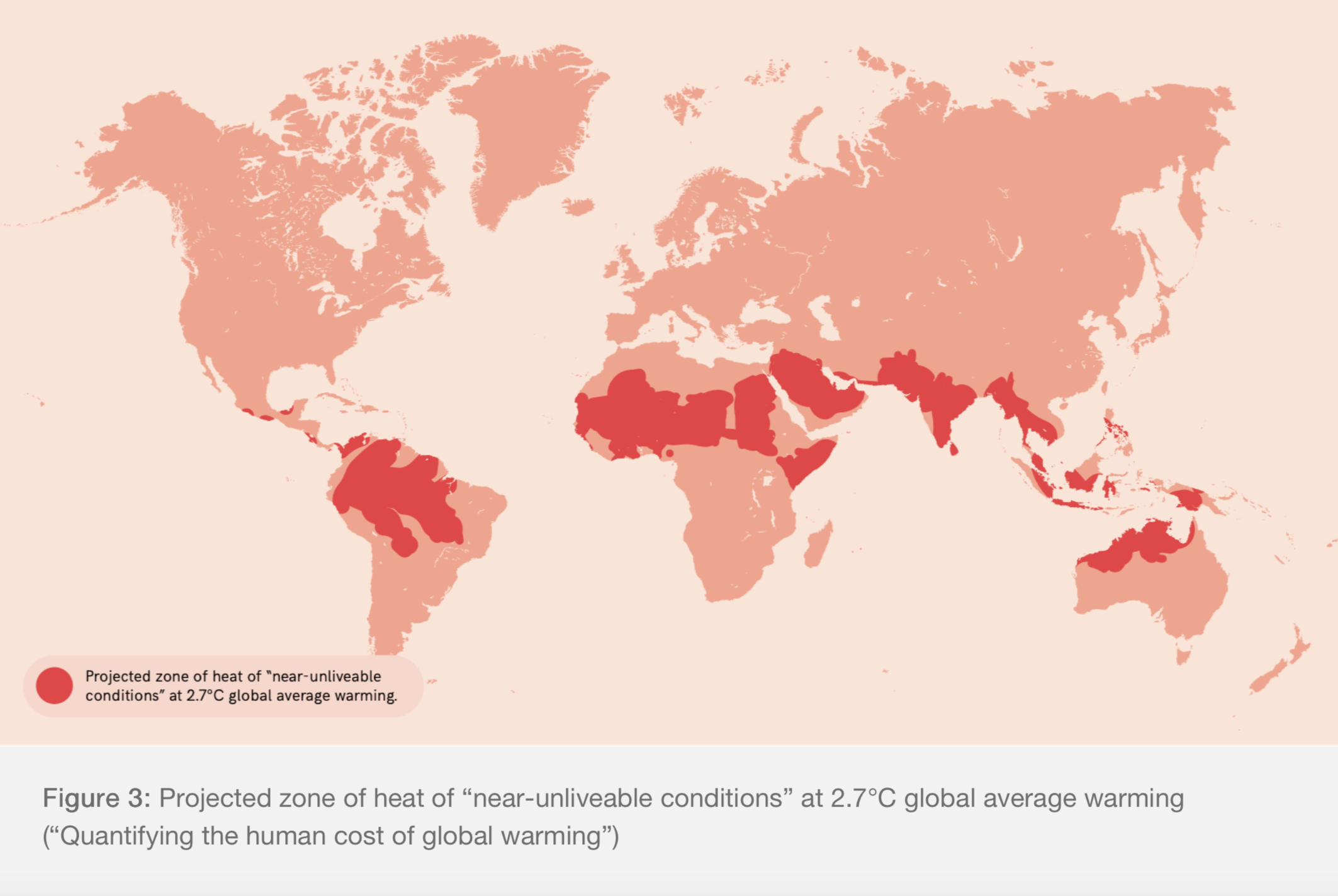
A 2020 study on extreme heat found that at 2.7°C, up to 3.5 billion people will be exposed to temperatures outside the “human niche”, that is, the climate conditions that have served humanity well over the past 6000 years. Further research published in 2023 described a zone of near unlivable heat, “a situation found in the present climate only in 0.8% of the global land surface, mostly concentrated in the Sahara, but in 2070 projected to cover 19% of the global land” (Figure 3). Prof. Marten Scheffer said those pushed outside the climate niche might consider migrating to cooler places: “Not just migration of tens of millions of people but it might be a billion or so.”
And at 2.7°C, scientists say that the Arctic would be “transformed beyond contemporary recognition: the Arctic Ocean would be essentially ice free for several months in summer, the area of Greenland that reaches melting temperatures for at least a month would roughly quadruple, and the area of permafrost would be roughly half of what it was in preindustrial times.”
Potsdam Institute Director Prof. Johan Rockstrom says that such a level of warming is “something that humanity has absolutely no evidence that we can cope with… Push ourselves to 2.5°C – we’re in unknown terrain. It would lead to a complete melting of the big ice sheets, which would be a 10-metre sea level rise… There would be a collapse of all the big biomes on planet Earth – the rainforest, many of the temperate forests – abrupt thawing of permafrost, we will have complete collapse of marine biology, we will have a shift of large parts of the habitability on Earth.”
Twenty years ago, a group of US security analysts constructed a 3°C scenario:
“Massive nonlinear events in the global environment give rise to massive nonlinear societal events. In this scenario, nations around the world will be overwhelmed by the scale of change and pernicious challenges, such as pandemic disease. The internal cohesion of nations will be under great stress, including in the United States, both as a result of a dramatic rise in migration and changes in agricultural patterns and water availability. The flooding of coastal communities around the world, especially in the Netherlands, the United States, South Asia, and China, has the potential to challenge regional and even national identities. Armed conflict between nations over resources, such as the Nile and its tributaries, is likely and nuclear war is possible. The social consequences range from increased religious fervour to outright chaos. In this scenario, climate change provokes a permanent shift in the relationship of humankind to nature’ (emphasis added).”
So how many would die, and how many would survive in this 3°C world?
Displacement and mortality
The “human niche” papers on near-unliveable heat found that these extremes are projected to envelop 1.2 billion people in India, 485 million in Nigeria and more than 100 million in each of Pakistan, Indonesia and Sudan. Many would be forced to move to a more liveable climate. Another study from the same year of 2020 concluded that warming of 2°C could provide more than 500 million people additional incentive to emigrate, whilst warming of 3°C could provide additional incentive-to-emigrate to well over a billion people.
The idea that a billion people may be displaced may seem fanciful, but the UN also agrees with this figure: “Unless we change the way we manage our land, in the next 30 years we may leave a billion or more vulnerable poor people with little choice but to fight or flee.”
The figures may be much, much higher than this, but there are so many variables, so many social unknowns, that any figure can only be a guesstimate by social scientists and security analysts, based on a scientifically-credible scenario.
Climate disruption kills people in many ways, including by direct physical impacts (heat stress, floods, cyclones and other extreme events), by severe food insecurity, through displacement and conflict, by increased disease and poorer health outcomes, and so on.
The 2025 report of the Lancet Countdown on health and climate changereported a 63% increase in heat-related deaths since the 1990s, reaching an estimated 546,000 yearly deaths on average in 2012–21. The higher number of heatwave days and drought months in 2023 compared with 1981–2010 was associated with 123.7 million more people experiencing moderate or severe food insecurity in 124 countries analysed. As hotter and drier weather increases the risk of wildfires, 2024 had a record-high 154,000 deaths from wildfire smoke-derived small particulate matter (PM2·5) air pollution.
What about future mortality rates? Joshua Pearce of the University of Western Ontario says if warming reaches or exceeds 2°C, it is likely that mainly richer humans will be responsible for the death of roughly one billion mainly poorer humans over the next century. This is based on a review of the literature by Pearce and Parncutt, which found mortality costs of carbon emissions converged on the “1,000-ton rule”: an estimate that one future premature death is caused every time approximately 1,000 tons of fossil carbon are burned. Their best- and worst-case figures were 300 million and three billion for 2°C.
By this logic, the mortality range at 3°C would be in the range of 450 million to 4.5 billion. Of course, this assumes a linear relationship between emissions and mortality, but that assumption is based on observed conditions that are far different from those humans will face in the second half of the century.
It should also be noted that in 2019, Rockström told The Guardian that in a 4°C-warmer world: “It’s difficult to see how we could accommodate eight billion people or maybe even half of that. There will be a rich minority of people who survive with modern lifestyles, no doubt, but it will be a turbulent, conflict-ridden world.”
So four billion dead at 3°C? Immediately or when the full physical and social impacts are realised over many centuries? Depending on deeply uncertain adaptation and other political responses? Between expert estimates of degrees of magnitude and worse-case conjecture, it’s complicated, but it will an appalling, unimaginably large number.


