We’ve Entered Climate Overshoot –
What Happens Now?
The World, The Universe And Us
The latest UN climate report is out and we’ve blown past 1.5 degrees of warming. We’re now in “overshoot” – an acknowledgement that global temperatures will rise beyond 1.5 degrees, but can theoretically be brought back down again through cooling efforts.
But with the world on track for 2.8 and even as much as 4.5 degrees of warming by 2100, is the challenge of keeping temperatures at a manageable level politically and technologically feasible?
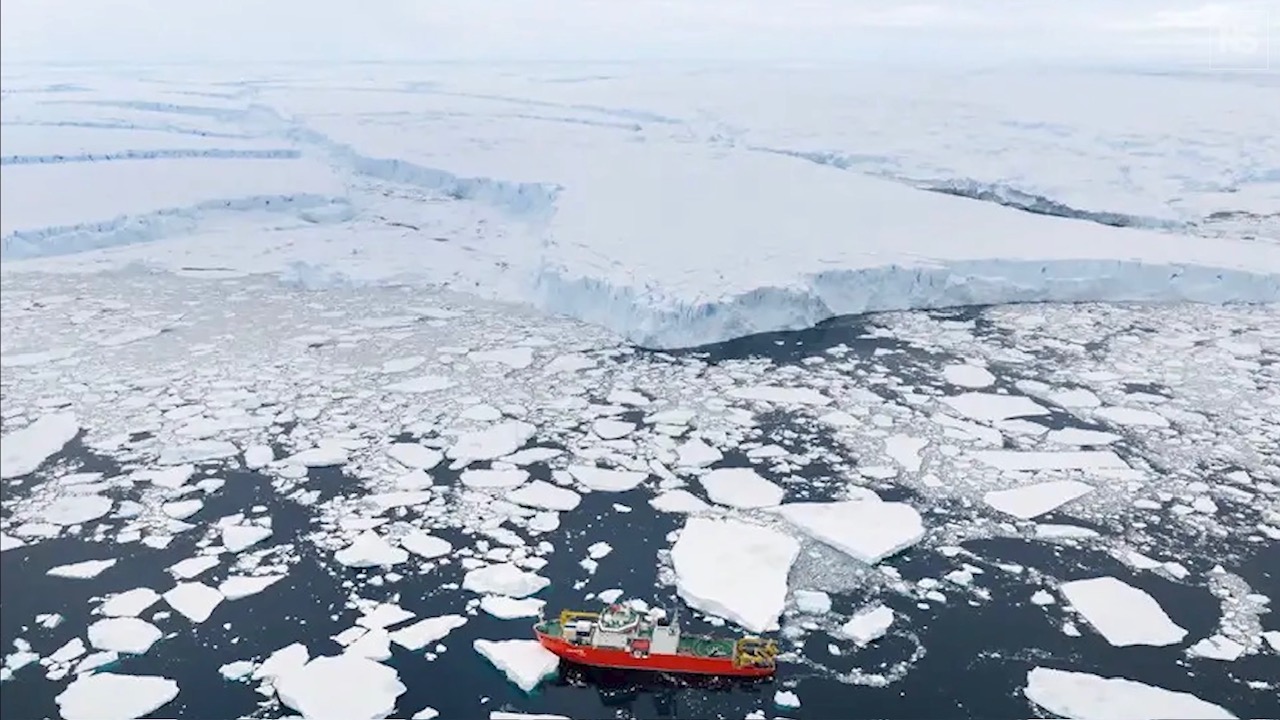
As scientists argue whether “overshoot” is failure conditions at Thwaites glacier in Antarctica are also worsening. The so-called “Doomsday” glacier is melting and an integral ice shelf is on the verge of collapse.
Now models show the melting is locked in – and can’t be stopped even if we keep global temperatures down. If it collapses, it could reshape the entire coastline of the world.
To discuss the news, Rowan Hooper and Penny Sarchet are joined by Madeleine Cuff and Alison George.
Opening transcript:
0:00 The latest UN climate report is out. Uh, we’ve blown past 1.5°. We’re now in overshoot. Current policies show warming of 2.8° C by 2100, but possibly 3.5 and even 4.5 is the stretch target.
0:17 Uh, we’re currently on track. This means for a scenario that has a significant chance of social breakdown and the failure of nation states.
0:24 Related to this, the latest modeling of the Thuait glacia in Antarctica, that’s often referred to as the doomsday glacia, suggests that 0:32 whatever happens to emissions, good or bad, uh, this glacia will now carry on losing ice for at least 150 years. From new scientists, this is the world, the universe, and us.
0:41 I’m Dr. Penny Sashe, and I’m Dr. Rowan Hooper. We’re joined today by climate reporter Meline Cuff and features editor Allison George.
0:50 Maddie, let’s start with overshoot. For people who might not be familiar with the term, what do people mean by that?
0:56 Overshoot is the term we generally use to describe keeping the 1.5 degree target within reach. As you said, Rowan, we it’s now impossible to just hold warming at that level.
1:04 We will exceed it. We’re kind of blocked into that. So, the idea with overshoot is that we go past that goal in the short term,
1:13 then hopefully bring it back down to that level in the long run. It’s like if you’re driving along a country road and you miss the turning and then you
1:21 perform a very high a highly dangerous maneuver to reverse back to take the turning and hope there’s not a tractor. Yeah. [clears throat] Exactly. Exactly.
1:29 So in general terms, overshoot means lowering global temperatures after we’ve reached net zero emissions. That will mean we rely on technologies such
1:37 direct air capture um in the latter half of the century to cool global temperatures back down to 1.5°.
1:44 So if 1.5 degrees is no longer achievable, then what’s the best that we could hope for? This is the lowest possible overshoot scenario that the UN set out
1:52 this week, which would see global temperatures peak at between 1.7 and 1.8° in midcentury. Um, and then we
1:59 would have a 50% chance of temperatures falling back to 1.5° by the end of the century.
2:06 This would not be easy to deliver. We would need to cut emissions by 18% by
2:13 the end of the decade, 45% by 2035, and 69% by 2040. That’s all relative to 2025 levels. Yeah.
2:21 To get on that pathway. And where we’re way off that now, right now, under our current pledges, emissions will only fall by between 5 to 8% by 2030. Hm.
Watch the podcast here.