
Yesterday (November 16) I nearly stranded myself on the interstate. My electric car didn’t fail me. Its range gauge did, confidently and by about a third.
Having had two previous surprise experiences with frightening near-zero battery, a week ago I planned three local trips (destination about 10 miles from home) and one longer trip (destination about 50 miles away) to conduct a test. I charged my 2024 Nissan Leaf to 100% and drove until the battery read zero (expecting to arrive home with plenty of battery to spare), logging the dashboard’s range estimate at every stop. At the start it promised 216 miles. The car went 160. I rolled into my driveway at 0%, with no buffer and no margin. (if there was much more than 2-3 miles reserve, I am not aware. Thankfully, the car went 2-3 miles beyond hitting zero.)
I knew it would be nip and tuck, so I found two charging stations at the far end of the neighboring town 13 miles before my exit. One had neither of the Leaf’s two plug types. The other was physically damaged and wouldn’t accept my credit cards. So I gambled that zero battery was not actually zero and hopped back on the interstate, assuming that, like a gas gauge, there is another half-gallon in the tank for 20 miles after the warning light started blinking.
My previous EV, a 2023 Subaru Solterra, had already given me the same scare. Two brands, two dashboards, the same optimism. I now read the range number the way I’d read a sales pitch: politely, and without believing it. That is an uneasy way to drive on a cold night, miles from the next charger.
I want electric cars to succeed. Net Zero plans assume millions of drivers will trade the gas gauge for a battery gauge, and that trade only works if the battery gauge tells the truth. Right now it doesn’t. The batteries and motors are ready. The range software is not ready for prime time.
The test
The method was simple enough for any EV owner to repeat:
- 1. Charge to 100%.
- 2. Drive mostly on the interstate, with stops along the way.
- 3. At each stop, record the odometer, the battery percentage, and the dashboard’s range estimate with the heater and air conditioning (HVAC) off and on.
- 4. Keep going until the battery approaches 0%. (Plan on 10%-20% at least.)
My test drives ran from odometer 9,585 to 9,745, exactly 160 miles. Outside temperatures ran from 40°F to 55°F over the week, which is ordinary fall weather for much of the country.
The key number is what I call actual miles remaining. Because I know the trip ended at zero after 160 miles, I can work backward: at any stop, the miles I still had left equal 160 minus the miles already driven. I can then put that number beside what the dashboard claimed at the same moment.
The results
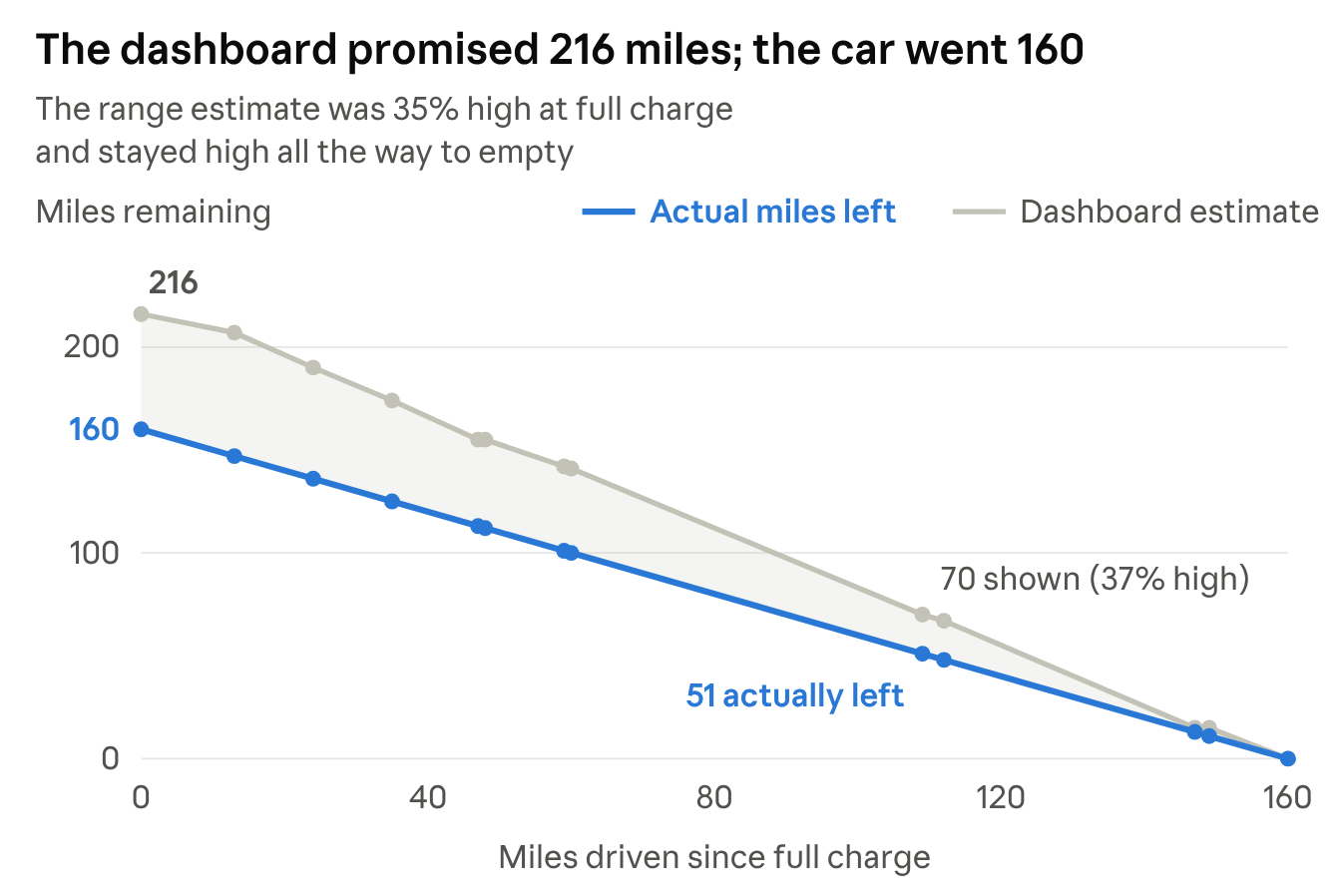
Author’s logged readings · 2024 Nissan Leaf, odometer 9,585–9,745 · 40–55°F · dashboard estimate with HVAC off most of the time.
The gap between the two lines is the whole story. At full charge the dashboard claimed 216 miles, but the car went 160. Put another way, I got 74% of what the dashboard promised, or the estimate ran about 35% high. That is the “about a third” in simple terms.
The error did not shrink as the trip went on. After 109 miles the dashboard showed 70 miles left when only 51 remained. With 11 real miles to go at the dysfunctional charging stations, it still showed 15. A gauge that is off by the same proportion all the way down is not having a bad moment. It is built on the wrong assumption.
The battery percentage, by contrast, tracked distance steadily. Each 1% was worth about 1.6 miles.
Why the gauge runs high
The dashboard number is not a measurement. It is a forecast: the car multiplies the energy left in the battery by the efficiency it expects you to get. If that expected efficiency is too optimistic, every reading is too high by the same proportion, which is exactly the pattern I saw.
Three things likely fed the optimism:
- 🔹 Rated range as the anchor. At a full charge the dashboard showed 216 miles. That is almost exactly the EPA rating of 212 miles for the 60 kWh Leaf SV PLUS (Nissan). The EPA figure blends city and highway driving in mild weather, and my trip was neither.
- 🔹 Highway speed. Air resistance rises steeply with speed. Unlike a gas engine, an electric motor gains little from steady cruising, so interstate driving is where EVs are least efficient.
- 🔹 Cold. At 40–55°F a battery delivers its energy less efficiently, and the car spends some of it keeping the battery and cabin warm.
One suspect turned out to be innocent: climate control. The dashboard’s “with HVAC” estimate was only 4 miles lower than its “no HVAC” estimate at the start, and just 1 mile lower near the end. Running the heater did not cause the shortfall.
None of this is secret to engineers. The problem is that the driver sees one confident number, with no hint of how much it depends on speed and weather.
Why this matters for Net Zero
Decarbonization plans for transportation lean heavily on ordinary people choosing electric cars. Engineering and policy debates usually focus on batteries, chargers and the grid. Trust gets less attention, but it may matter just as much.
A gas gauge that read a third high would be a scandal. Drivers learned long ago that “empty” on a gas car still leaves a cushion. With an EV, the cushion can run the other way, and a stranded EV cannot be fixed with a gas can.
So a small software choice ends up working against a large public goal. Every overstated estimate hands a skeptic a true story to tell. If the range gauge were conservative instead, drivers would arrive home with miles to spare and tell a different story.
This also feeds into the wider Net Zero conundrum this site keeps returning to. Targets are set in policy documents, but whether they are met depends on millions of small, private decisions. Those decisions are shaped by experiences like mine on the interstate.
What EV drivers can do now
- 🔹 Trust the battery percentage more than the miles. On this trip, each 1% of battery was worth about 1.6 miles. Learn your own number for highway driving in cold weather, and do the arithmetic yourself.
- 🔹 Discount the dashboard on cold highway trips. Based on this test, plan on about three-quarters of the miles shown.
- 🔹 Plan a charging stop with a buffer. Aim to arrive at a charger with at least 15–20% left, not with whatever the dashboard says you’ll have.
- 🔹 Run your own test. Charge to 100%, note the dashboard estimate, and log odometer and battery percentage at each stop. It takes one long drive and a notebook.
A challenge to EV software architects
Stop making baseless assumptions, and ask the driver by displaying an optional, simple menu of key variables:
- 🔹 Temperature. Use the current outside temperature, and let me say whether it will get warmer or colder along the way.
- 🔹 Speed. Let me pick my planned cruising speed: around town, 55, 65, or 75 mph.
- 🔹 Climate control. Let me say whether the heat or air conditioning will be off, moderate or full, including seat and steering-wheel heaters.
- 🔹 Everything else that matters. Let me flag interstate or hills, wind and rain, a full load of passengers and cargo, a roof rack or a trailer.
Then show me an honest answer, as a range instead of a single number: “At 70 mph, 40°F, heat on: 150–170 miles.”
Here is what stings: the car already knows the outside temperature, and it knows whether the heater is on. On my trip it either ignored that information or gave it too little weight. What it cannot know is what the driver knows: how fast I plan to go, what the forecast says, and what the road ahead looks like. Some navigation systems adjust their estimates once you enter a destination. The main gauge, the number drivers actually glance at, should be just as smart.
To be fair, predicting range is genuinely hard, and no software will get it exactly right. But when it errs, it should err on the side of the driver. A gauge that arrives with miles to spare builds confidence. A gauge that runs a third high wears it away, one near-stranding at a time.
Have you tested your own EV?
Whatever the make, I’d like to hear what your dashboard promised and what you actually got. Please share your numbers in the comments. Automakers, if you’re reading, I’m happy to beta-test the menu.
BTW, I will be taking the Leaf in for an HVAC reprogramming recall on Thursday and will discuss this with the service manager, sharing the actual odometer and battery gauge readings.


