
LTE: The Guardian View on COP31
Letter to the Editor from a colleague
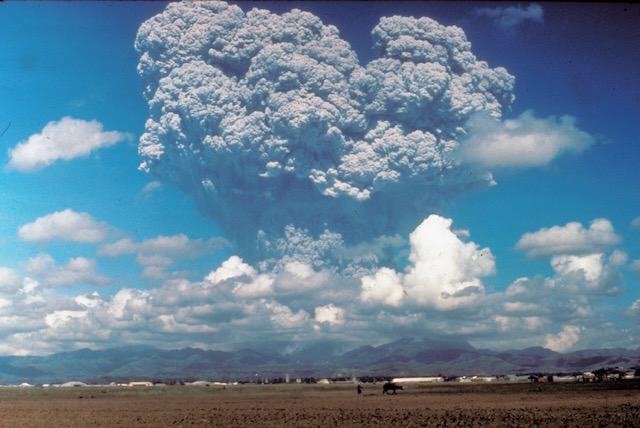
Ash cloud of Pinatubo during 1991 eruption 12 June 1991 | Author: Dave Harlow, United States Geological Survey | Permission: public domain image from the United States Geological Survey | Source: http://vulcan.wr.usgs.gov/Volcanoes/Philippines/Pinatubo/images.html
2026-11-25
To the Guardian for publication
Dear Editor,
(Re “The Guardian View on COP31”, 24/11/26) COP31 has hit a dead end. The COPs were to protect the world from dangerous climate change through CO2 emission cuts. But cuts haven’t materialised and, at 1.5C, the global temperature is already dangerous. Thousands died of heat in the UK this year, and millions died worldwide.
The global temperature is now rising nearly four times faster than in the last century. And the Arctic is in rapid meltdown, having been warming nearly four times faster still.
Professor Wadhams is an expert on sea ice and author of the book “A farewell to ice”. He and I gave evidence in 2012 to a UK select committee’s inquiry on protecting the Arctic, warning that cooling intervention had to be considered. Unmitigated Arctic meltdown risks a sudden partial collapse of several key tipping elements of the Earth System with potentially catastrophic consequences: for example, even within a few decades, the Greenland Ice Sheet (GIS) could produce half a metre of sea level rise and the Atlantic Meridional Overturning Circulation (AMOC) could drastically change climate in many parts of the world, but especially in Western Europe, giving us freezing winters and hotter summers.
Since emissions cuts alone cannot save us in time, governments must look to rapid deployment of interventions both to cool the planet and, even more urgently, to halt Arctic meltdown. Drawing on how volcanic eruptions* naturally lower global temperatures by releasing sulphur dioxide into the upper atmosphere to form a reflective haze, scientists have developed Stratospheric Aerosol Injection (SAI). Inexpensive and surprisingly benign, SAI is not a substitute for decarbonisation in the long run, but it would be a stopgap to defuse the immediate crisis ideally with a target of full-scale deployment within five years. Temperatures can be quickly lowered to safe levels.
Yours sincerely,
John Nissen
Chair of the Planetary Restoration Action Group, PRAG
*More on how volcanic eruptions naturally lower global temperatures
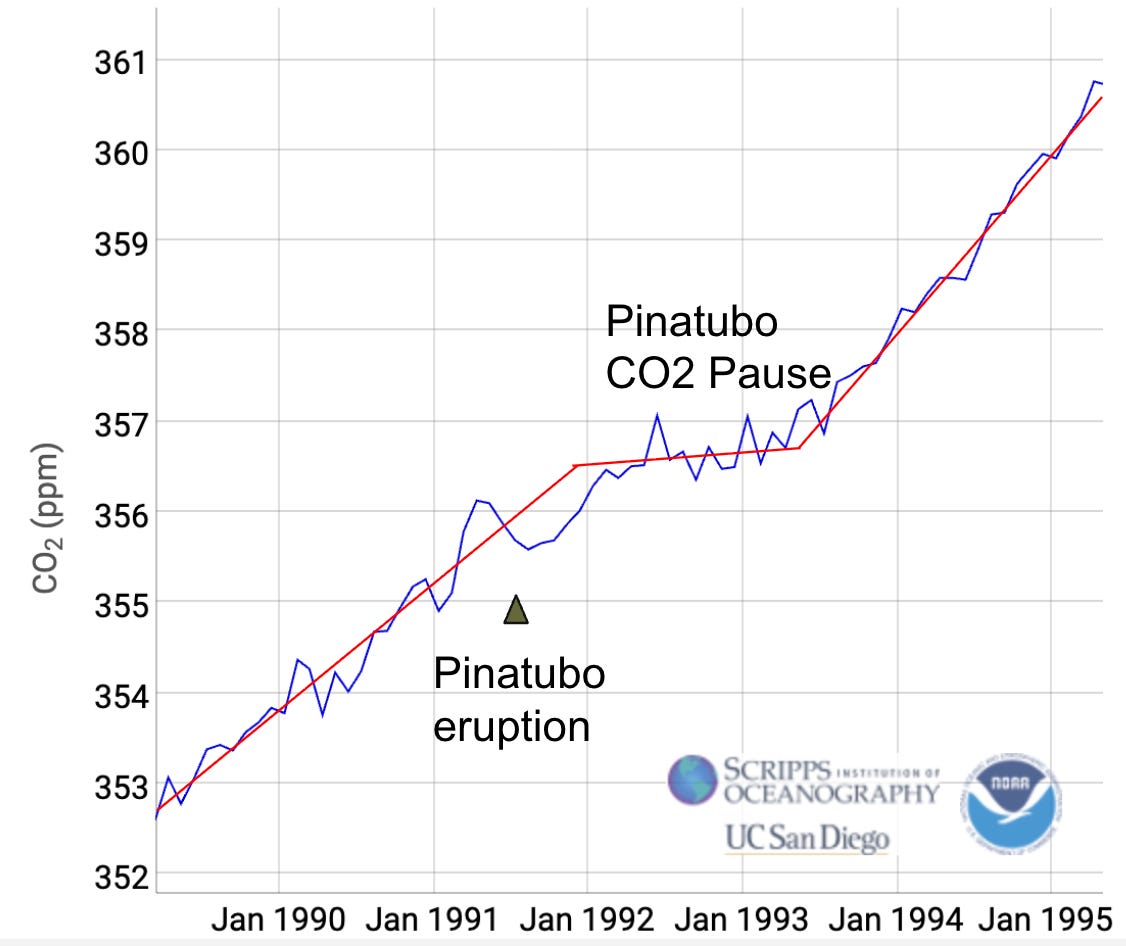
See also Mt. Pinatubo’s effect on the Keeling Curve
A New Pilot Project Opens the Path to Net-Zero by 2030


Pingback: A New Pilot Project Opens the Path to Net-Zero by 2030 | 2012 is the End of the World as We Know It … 2013 is the New Beginning. Go Slow Quickly!