
COP31 will be history come this weekend … yesterday (Tuesday) one of the brilliant engineers who participates in the Healthy Climate Action Coalition circulated a proposed pamphlet for COP31 participants, which to my mind reveals the desperation and lack of strategic thinking that exists within the climate activist community.
I think it is instructive to critique this in order to change our collective approach, so here goes with assistance of Claude AI, which I have learned is quite capable and extremely fast at researching and linking information in disparate sources. I am careful to question and direct Claude, just as Claude corrects errors in my query statements and in my understanding of the myriad bits of information.
Judge for yourself:
The E-mail
HPAC Colleagues,
Courtesy of Robbie’s ChatGPT help with the graphic, here is the single sheet pamphlet I have produced for COP31 attendees and others who might appreciate the paradigm shift we promote.
FYI, it is the Prime Minister of Tonga who is driving the blue car and one of the Turkiyean dancers who welcomed dignitaries to the COP who is encouraging Antonio Guterres and Christiana Figures to change paths and paradigms. The PM is figured because he has agreed that his scientists will supervise a sea trial by an international consortium of research institutes of my Buoyant Flakes in national Tongan waters. Both the chlorophyll from the resulting phytoplankton and the marine cloud resulting from their DMS emissions should increase albedo and hence cool island waters. The Alpage destination is the safe, green territory named by the French Swiss for their high, cool, summer pastures. The terrain is based on the diagram in the academic paper Manage derailment risks to avoid Hothouse Earth by Dyke, Laybourn & Abrams (2026), see https://iopscience.iop.org/article/10.1088/1748-9326/aeb1de?utm_source=chatgpt.com.
Feel free to use this material wherever.
The Pamphlet
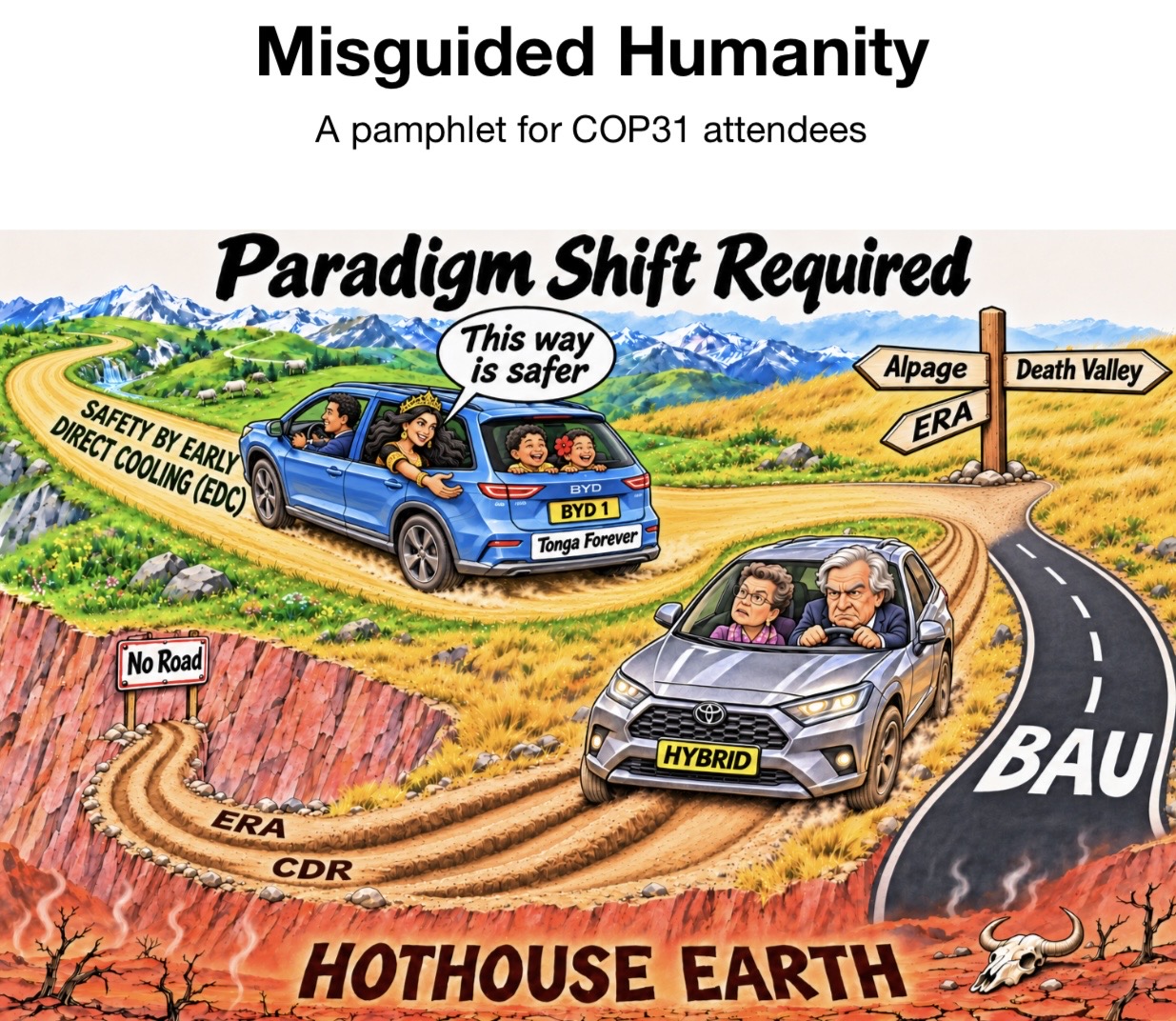
The Conference of Parties (COP) process to restore the biosphere and planetary climate has not served humanity well. It is almost as if it had been designed to fail by its architects or their patrons. By ignoring the appropriate risk management approach in favour of inappropriate and over-delayed peer-reviewed scientific ‘certainty’; by allowing politics and the lowest common denominator of petrostates to interfere with the Intergovernmental Panel on Climate Change (IPCC’s scientific guidance to policy makers; by avoiding or attacking direct cooling methods in favour of emissions reduction and removal methods; and by suppressing (or virtually ignoring or concentrating only on their fancied risks whilst ignoring the risks of inaction) of ocean-based, rebrightening and evaporative methods, there has resulted an unconscionable delay of more than three decades on the investigation, modelling and optimisation of timely and effective climate intervention measures.
The most misguided and unnecessarily divisive result is that focus has been on the growing concentration of carbon dioxide in the atmosphere, which although it is the prime cause of global warming, is not the main risk, which is escalating global temperature. Moreover, the main threat now comes from the escalation of Earth’s (Radiative) Energy Imbalance (EEI). It is not the level of atmospheric carbon dioxide as paleo studies have shown that mammals have survived well when the level in the early Cenozoic Era was ~ 1600ppm, (see Toward a Cenozoic history of atmospheric CO2 in Science) or more than three times the current level, ~429ppm. It is surmised that a combination of increased evapotranspiration which cause heat to move efficiently off-planet and increased cloudiness which increases solar reflection (albedo) would have been the main causes of EEl and temperatures not being excessive for mammalian (and probably marine organisms in the upper waters) life. It is also relevant that Al reports that:
The stock of dissolved bicarbonate in the ocean is roughly 100 times larger than proven oil and natural gas reserves combined, and nearly 5 times larger than total estimated oil and gas resources. Measured in gigatons of carbon (GtC), oceanic bicarbonate holds approximately 33,300 to 34,800 GtC, compared to 345 GtC in proven non-coal fossil fuel reserves.
This indicates that continuing to mine and use oil and natural gas, but at a reducing rate consistent with a minimally-disruptive move to sustainable energy sources, would not be inimical to humanity or the biosphere. In other words, provided that we focus on EEI reversal by direct cooling methods, there needs be no stultifying macro-contest between industry, government, populace and good environmental stewardship. At the same time, we should of course ensure that emissions of all greenhouse gases (GHG), both natural and anthropogenic, are monitored and progressively reduced, and that GHG removal (or CDR) methods are funded, evaluated, selected, optimised, legalised, governed and deployed at scale in short order by whatever means. Only thus are we likely to avoid increasingly existential climate risk.
The Analysis
Now, this is “over my pay grade” as they say, so I turned to Claude AI with this query:
Summarize and critique the PDF Pamphlet transmitted to HPAC Google Group: intended and appropriate audiences, least appropriate audiences, clarity of the message, effectiveness, understandable images
Claude rephrased the three paragraphs in the simplest of terms, as follows:
PARAGRAPH #1: The pamphlet argues that the UN climate summits have failed: leaders waited too long for scientific certainty, let oil-producing countries water down the science, and dismissed ideas for cooling the planet directly. The result, it says, is more than 30 years lost when we could have been developing those cooling methods.
PARAGRAPH #2: The pamphlet argues that the real danger isn’t CO₂ itself but the build-up of heat on Earth, and points to a time 50 million years ago when CO₂ was three times higher yet mammals thrived. It suggests more evaporation and more clouds kept that ancient world cool enough for life.
PARAGRAPHS #3 and #4: Citing an AI estimate that the oceans hold far more carbon than all the world’s oil and gas, the pamphlet argues we can keep using fossil fuels while phasing them down, as long as we focus on cooling the planet directly. It still calls for cutting heat-trapping gases and quickly scaling up ways to remove them from the air.
What audiences are best suited to the original pamphlet and Claude’s very short version? Which do you prefer? Perhaps there is a middle ground, which Claude initially provided in response to my queries:
Summarize the first paragraph in easy to understand layman’s terms for readers of my WordPress TellRex.com
Summarize the second paragraph in easy to understand layman’s terms for readers of my WordPress TellRex.com as above. Similarly, a very short version as you did for the first paragraph
Summarize the third paragraph in easy to understand layman’s terms for readers of my WordPress TellRex.com as above. Similarly, a very short version as you did for the first and second paragraphs
Which of the original, very concise or “plain English” (below) do you understand best and prefer?
PARAGRAPH #1:
In plain English: The pamphlet argues that the UN’s yearly climate summits (the “COPs”) have let people down, so badly that it’s almost as if they were meant to fail. It gives four reasons:
- Waiting for proof. Leaders waited for full scientific certainty before acting. The pamphlet says they should have handled climate the way you’d handle any big risk: act early, before it’s too late.
- Oil-producing countries got too much say. Countries that depend on oil and gas were allowed to water down the scientists’ advice to governments.
- The focus was too narrow. Nearly all the attention went to cutting pollution and pulling carbon out of the air. Ideas for cooling the planet directly, such as making clouds or the ocean surface reflect more sunlight, were brushed aside or attacked.
- Only one side of the risk was weighed. Critics of these cooling ideas talked only about what might go wrong if we try them. They didn’t count the dangers of doing nothing.
The result, the pamphlet says, is more than 30 years lost when we could have been testing and improving ways to cool the planet in time.
Editor’s note: Claude wrote it as “the pamphlet argues” so it reads as a fair summary of the author’s view rather than as your own position.
PARAGRAPH #2:
In plain English: The pamphlet says the biggest mistake has been treating the amount of carbon dioxide (CO₂) in the air as the main problem. It agrees that CO₂ is what’s warming the planet. But it argues the real danger is the rising temperature itself, and above all the growing energy imbalance: Earth is taking in more heat from the sun than it gives off back into space, so heat keeps building up.
To show that CO₂ levels alone aren’t the threat, it points to Earth’s distant past. About 50 million years ago, CO₂ was around 1,600 parts per million, more than three times today’s level of about 429, and mammals still thrived. The author’s theory is that two natural processes kept conditions livable then:
- More evaporation from plants and land, which carried heat up and away from the surface so it could escape to space
- More clouds, which reflected more sunlight back into space before it could warm the planet
Editor’s note: The study the pamphlet cites also describes how hot that ancient world was. Researchers confirmed the long-held belief that the hottest period was about 50 million years ago, when CO2 spiked to as much as 1,600 ppm, and temperatures were as much as 12 degrees C higher than today. There were no polar ice caps then and sea levels were far higher. That warming also happened over many thousands of years, which gave plants and animals time to adapt. Today’s changes are happening within a few human lifetimes. The study itself does not radically revise the generally accepted relationship between CO2 and temperature, and it supports the view that long-term climate is highly sensitive to greenhouse gas. In other words, the scientists see that ancient world as a warning about high CO₂, not a reassurance. columbia
PARAGRAPH #3 and #4:
In plain English: The pamphlet quotes an AI tool’s estimate that the ocean holds a huge amount of carbon, dissolved in seawater as a natural compound called bicarbonate. By that estimate, the ocean holds about 100 times more carbon than all the oil and gas we know we can extract, and about 5 times more than all the oil and gas thought to exist.
From this, the author concludes that we can keep using oil and gas for now without harming people or nature, as long as we use less over time and move steadily to clean energy. The key condition is that we also work directly on cooling the planet. Done that way, the author says, industry, governments, the public and environmentalists wouldn’t have to be locked in a bitter fight.
The pamphlet still says we should:
- Track and cut all heat-trapping gases, both natural and human-made
- Quickly fund, test, approve and scale up ways of pulling those gases out of the air
Only by doing all of this, it concludes, can we avoid climate dangers that could threaten our survival.
Editor’s note: The size of the ocean’s carbon store doesn’t show that burning oil and gas is harmless. That carbon is already part of the natural system and doesn’t cancel out new carbon we add. When we burn fossil fuels, the carbon goes into the air first. The ocean then takes some of it up: it absorbs about 30 percent of the CO2 that is released in the atmosphere. That has a cost. When CO2 is absorbed by seawater, a series of chemical reactions occur that make the water more acidic. Since the industrial revolution, the ocean surface has seen approximately a 30 percent increase in acidity, which makes it harder for shellfish, corals and tiny sea creatures to build their shells and skeletons. noaa noaa
The ocean also works slowly. The air mostly touches the surface layer, and exchanges of CO2 with the deep ocean are much slower, taking place on timescales from centuries to millennia. So the ocean’s vast reserve can’t soak up our emissions fast enough to protect us in the coming decades. ucl


