
A 2026 Status Report — October 17, 2026
World oil production rose 17% between 2012 and 2025, from 86.2 to a record 100.6 million barrels per day, while the number of refineries stayed roughly flat. More than a decade into the push to decarbonize, the world is processing more oil through about the same number of plants, not less.
The wars in Ukraine and the Middle East have damaged dozens of refineries in 2025 and 2026. Almost none have closed for good. Most were repaired and restarted, so war shows up as lost output and higher prices, not as a smaller refinery count.
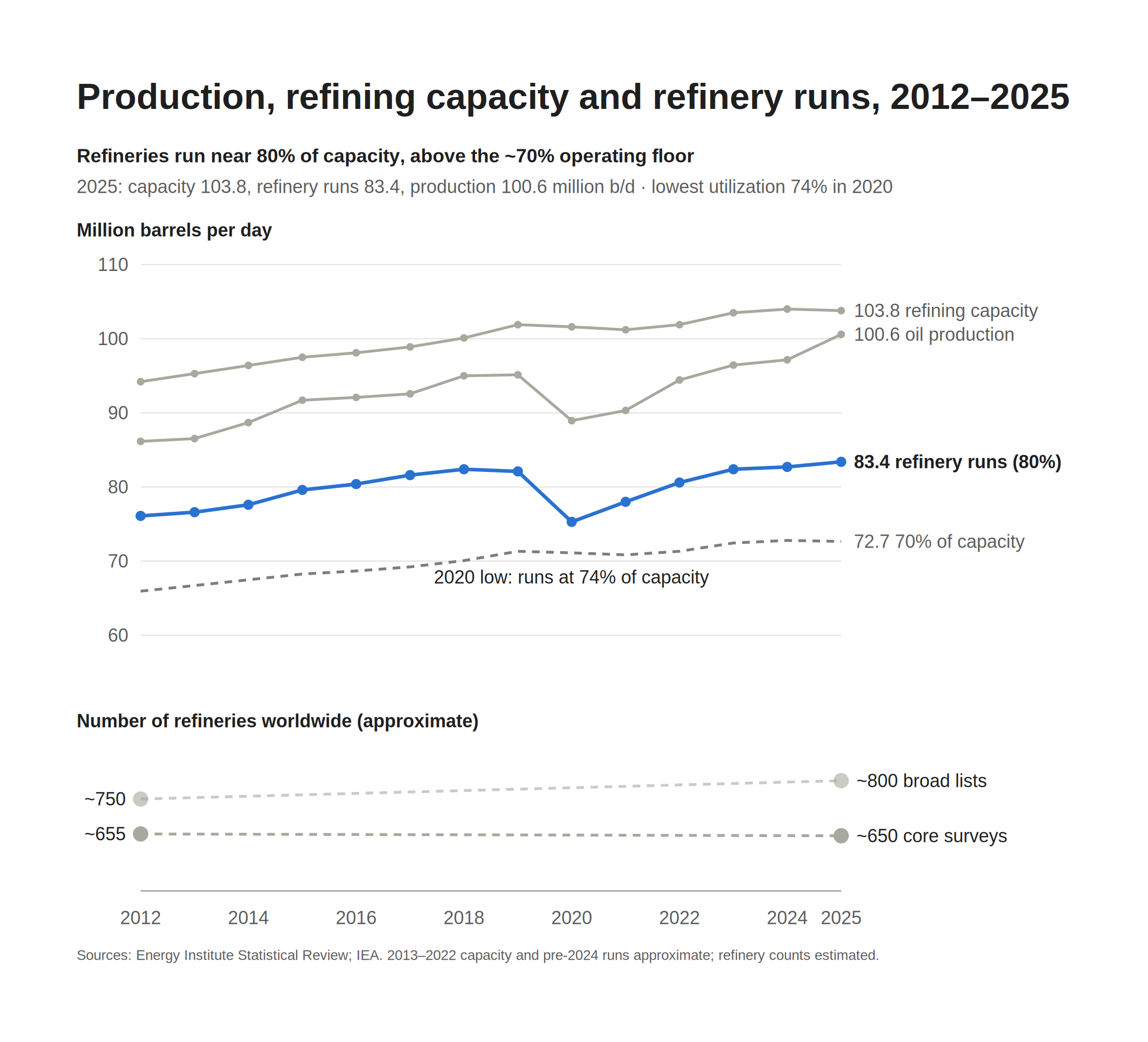
The numbers pass the 70% sanity check. A rule of thumb from refinery operators is that a running refinery cannot turn down much below about 70% of its capacity. Worldwide, refineries actually processed about 80% of their capacity in most years, and even the 2020 pandemic only pushed that to 74%, just above the floor.
Production sits much closer to refinery capacity (about 97% in 2025), but that comparison is misleading. Production includes roughly 13 million b/d of natural gas liquids, such as propane and ethane, most of which go to petrochemical plants and heating fuel without passing through a refinery. Refinery runs are the right figure to compare with capacity.
The 70% rule applies to individual plants, so the global average is only a rough check: some refineries run near 95% while others sit idle for repairs. Capacity figures for 2013– 2022 and run figures before 2024 are approximate values from Energy Institute tables.
The refinery counts are shown only at the two ends because no agency publishes a yearly global tally.
How many refineries are there?
The best current estimate is about 650 to 700 operating refineries, with total capacity near 104 million barrels per day. An industry compilation of IEA, EIA, OPEC and Oil & Gas Journal data puts the 2025 figure at 650+ refineries and 103.3 million b/d. Brazil’s ANP, citing the Energy Institute, puts 2025 capacity at 103.8 million b/d, down 0.3% on 2024.
You will also see figures of 750 to 825. The difference is definition, not growth. Broader databases count small topping plants, asphalt plants and China’s independent “teapot” refineries, which the standard surveys leave out or group together.
On either basis, the count in 2025 is close to where it was in 2012. What changed is size and location. Older, smaller plants in the US, Europe and Japan closed; fewer but much larger plants opened in Asia, the Middle East and Africa. The US alone has 131 active refineries, down from a peak of 254 in 1982.
Refineries hit by war
Dozens of refineries have been struck since 2025, but the confirmed permanent closures from war damage are close to zero. Damaged units are repaired and restarted, often repeatedly.
Russia. By late June 2026, CNN counted more than 300 Ukrainian strikes on Russian oil facilities since 2022, most of them from mid-2024 on. According to the IEA, some of Russia’s 32 refineries have been hit up to 15 times, and Ukraine’s defense ministry claimed in October 2026 that 51% of Russian capacity was disabled. That figure is Kyiv’s own and is not independently verified. Strikes resumed on October 15 when drones hit the Ryazan refinery after a three-day pause.
Middle East. Since the US-Israeli strikes on Iran began on February 28, 2026, Iranian missiles and drones have hit refineries across the Gulf. Consultancy IIR estimated nearly 1.9 million b/d of Gulf refining capacity was shut in the war’s second week. A July review found that more than half of the region’s 73 active refineries had been struck, and that Kuwait’s Mina Abdullah plant remained shut for repairs. Inside Iran, US and Israeli strikes hit the Tehran refinery and several fuel depots in March. Iran’s oil minister said in September that much of the damaged capacity had been rebuilt.
The net effect on the count is small. The effect on supply is large: at any given moment in 2026, a meaningful share of Russian and Gulf capacity has been offline.
New refineries versus closures
From 2024 to 2026, a handful of very large refineries opened and a similar number of older ones closed. The plant count is roughly a wash; capacity is flat to slightly up.
| Opened/ ramp up | Capacity (bbl/day) | | | | | Closed/ closing | Capacity (bbl/day) |
| Dangote, Nigeria | 650,000 | | | | | Dalian (PetroChina), China | 200,000 |
| Dos Bocas (Olmeca), Mexico | 340,000 | | | | | Grangemouth, UK | ~150,000 |
| Yulong, China | 400,000 | | | | | Valero Benicia, California | ~145,000 |
Kpler expected 765,000 b/d of crude capacity to shut in 2025. BloombergNEF reported that global capacity shrink in 2025 for the first time since 2021, then forecast net growth of 708,000 b/d in 2026. That forecast predates the Iran war. The Grangemouth and Benicia capacities are approximate.
What this means for decarbonization
By the numbers, decarbonization has not yet reduced global oil use. The Energy Institute’s 2026 Statistical Review reports oil consumption up 1.3% in 2025 to 103 million b/d, and energy-sector CO2 emissions up 1.1% to a record 35.8 billion tonnes. Oil production has risen in every year since 2012 except the 2020 pandemic dip.
The refinery closures in Europe and the US are mainly about economics: weak margins, aging plants and competition from new Asian and Middle Eastern mega-refineries. Some owners cite expected demand decline, but so far that capacity has moved, not disappeared.
The two readings people draw from this differ:
• Transition advocates point to electric vehicles flattening gasoline demand in China and Europe, and argue the 2026 supply shocks will speed the shift. The Energy Institute itself likened the moment to the 1970s oil shocks, which cut oil use for years.
• Skeptics point out that each year of record production makes net-zero-by-2050 targets harder, and that wartime fuel shortages have pushed governments to prioritize energy security over emissions.
The plain fact is that the world’s refining system is about as large as it was in 2012 and is running more oil than ever. Whether 2025 marks a peak will depend on how demand responds to the 2026 price shock.
Sources and caveats
Production figures are the Energy Institute’s crude oil plus natural gas liquids series, via YCharts. No agency publishes an annual global refinery count, so the 2012 counts in the chart are approximate estimates and the 2025 counts reflect current industry compilations. War-damage figures change weekly; this report reflects reporting through October 17, 2026.
- Energy Institute Statistical Review 2026 summary (DieselNet)
- Global Oil Refinery Industry statistics (BusinesStats)
- ANP Statistical Yearbook 2026, Section 1
- 2025–2026 Russian fuel crisis (Wikipedia)
- AP via PBS: Ukraine claims half of Russian refining disabled
- OilPrice: Ukraine strikes Ryazan refinery
- Reuters via PGJ: 1.9 million b/d of Gulf capacity shut
- Polymerupdate: Iranian attacks hit over half of Middle East refineries
- Al Jazeera: Iran oil facilities hit
- Bernama: Iran says refining capacity rebuilt
- Kpler Refinery Monthly Report, May 2025
- BloombergNEF Global Oil Refinery Quarterly
- Statista: US refinery count
- Statbase: global refining capacity 2025 (Energy Institute data)
- EIA Outlook on global refining to 2028
- IEA global refinery runs estimates
This report was researched and drafted by Claude, an AI assistant made by Anthropic, at the request and under the direction of the author for TellRex.com. The author chose the topic and scope and reviewed the final text.


